Order to Execute French Prisoners at Agincourt
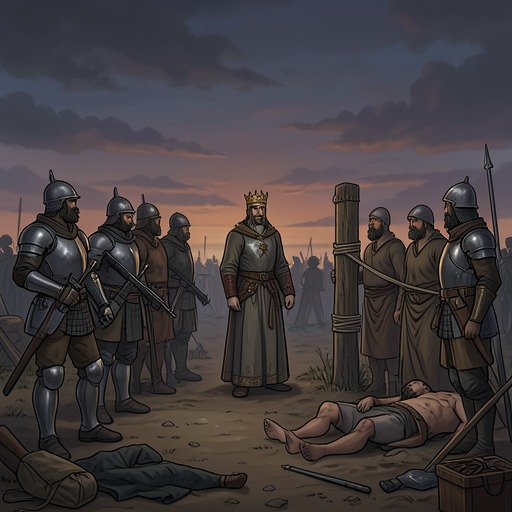
Henry VThe Order to Execute French Prisoners at Agincourt is a command by King Henry V during the battle, issued after an alarm announces that the French have reinforced their scattered forces. The play places the order beside reports of slaughter among the English boys and the plundering and burning of the king’s tent. The immediate cause given onstage is retaliation; the larger consequence is to expose the violence and moral strain within a campaign repeatedly framed through questions of justice, responsibility, and royal authority.
Background and Stakes
The command follows a new alarm in the battle. The French have reinforced men who were scattered, changing the situation from a moment of apparent English advantage to renewed danger. King Henry V responds with a brief imperative, directing every soldier to kill his prisoners and have the order passed along. Its reach is categorical: the instruction is not limited onstage to a named prisoner or a particular act, but applies to the captives held by the soldiers.
That decision lands in a play that has already put the grounds and costs of war under scrutiny. In the council discussion of the Salic Law, the right to make a claim in France is argued as a matter of law and religion; a warning to the king invokes God and cautions him against awakening war, emphasizing the blood that contention between kingdoms will shed. These earlier concerns do not explain the battlefield decision, but they establish a standard against which the command can be measured: a war argued in the language of lawful right and religious duty also produces choices about what may be done to defeated enemies.
The Command and Its Immediate Context
The stage sequence makes the order sudden. An alarm sounds; the news that the French have rallied is followed at once by King Henry V’s instruction. The command is then to be carried through the ranks. The scene moves away from the king, and Captain Fluellen and Captain Gower enter in another part of the field, where the order’s effects and circumstances become the subject of conversation.
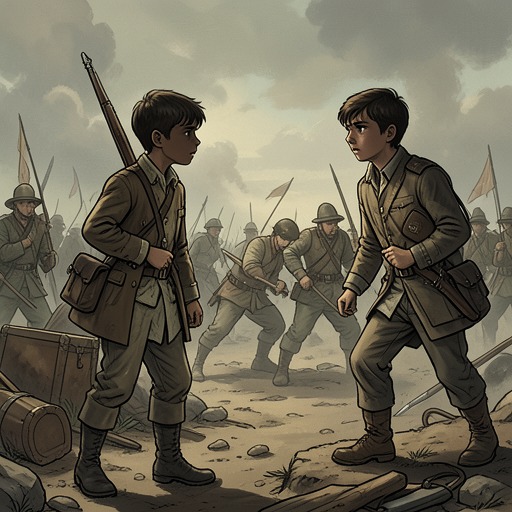
Captain Gower reports that not a single boy has been left alive. He attributes the slaughter to English fugitives who ran from the battle, and adds that they burned and carried away everything in the king’s tent. His account supplies a direct cause for the king’s response: the executions follow the news of attacks on vulnerable members of the English camp and the loss of the royal tent. The play thus places two forms of violence in close sequence, but does not make them identical. Gower identifies the English fugitives as responsible for the killing of the boys; King Henry V’s order, by contrast, falls on French prisoners.
Retaliation and Responsibility
The scene gives the command a comprehensible battlefield trigger without removing its moral weight. Gower presents the deaths and the destruction of the tent as the reason the king has caused each soldier to cut his prisoner’s throat. His explanation is admiring, even as the action it describes is severe. Captain Fluellen’s presence as the conversation turns to the order keeps it in view as a matter for discussion rather than allowing the king’s command to pass as an impersonal detail of battle.
Elsewhere, John Williams articulates the burden of responsibility that complicates royal claims to lead a just war: if the cause is not good, he argues, the king will face a heavy reckoning when the bodies of those killed in battle bear witness against him. That argument concerns the justice of the campaign, not specifically the treatment of captives. Set beside the execution order, however, it makes the play’s moral problem harder to evade. Authority can direct an army and answer violence with violence, but command alone does not settle the question of responsibility.
Dramatic and Ethical Significance
The placement of the order disrupts a straightforward celebration of victory. The renewed French attack creates an immediate military crisis; the report of the dead boys and the burned, plundered tent gives the king’s response a motive; and the treatment of prisoners makes the consequences of that response visible. The scene’s force comes from the compression of these elements, not from an extended defence of the decision. The king orders the killings, while the surrounding dialogue records both the losses that precede them and the human cost of the command.
The episode therefore sharpens a tension running through the play between the justification of war and the conduct of war. Earlier, King Henry V threatens that mercy will be withdrawn in the siege of Harfleur; at Agincourt, the order against prisoners turns the danger of violence into an action reported as carried out. The circumstances differ, and the play does not equate the two moments, but together they show how royal power can make threatened or retaliatory violence part of military policy. The scene leaves victory inseparable from the question of what the victors have done to those in their power.